Fertilizer & Application Tutorials
Foliar Feeding vs Soil Application vs Fertigation
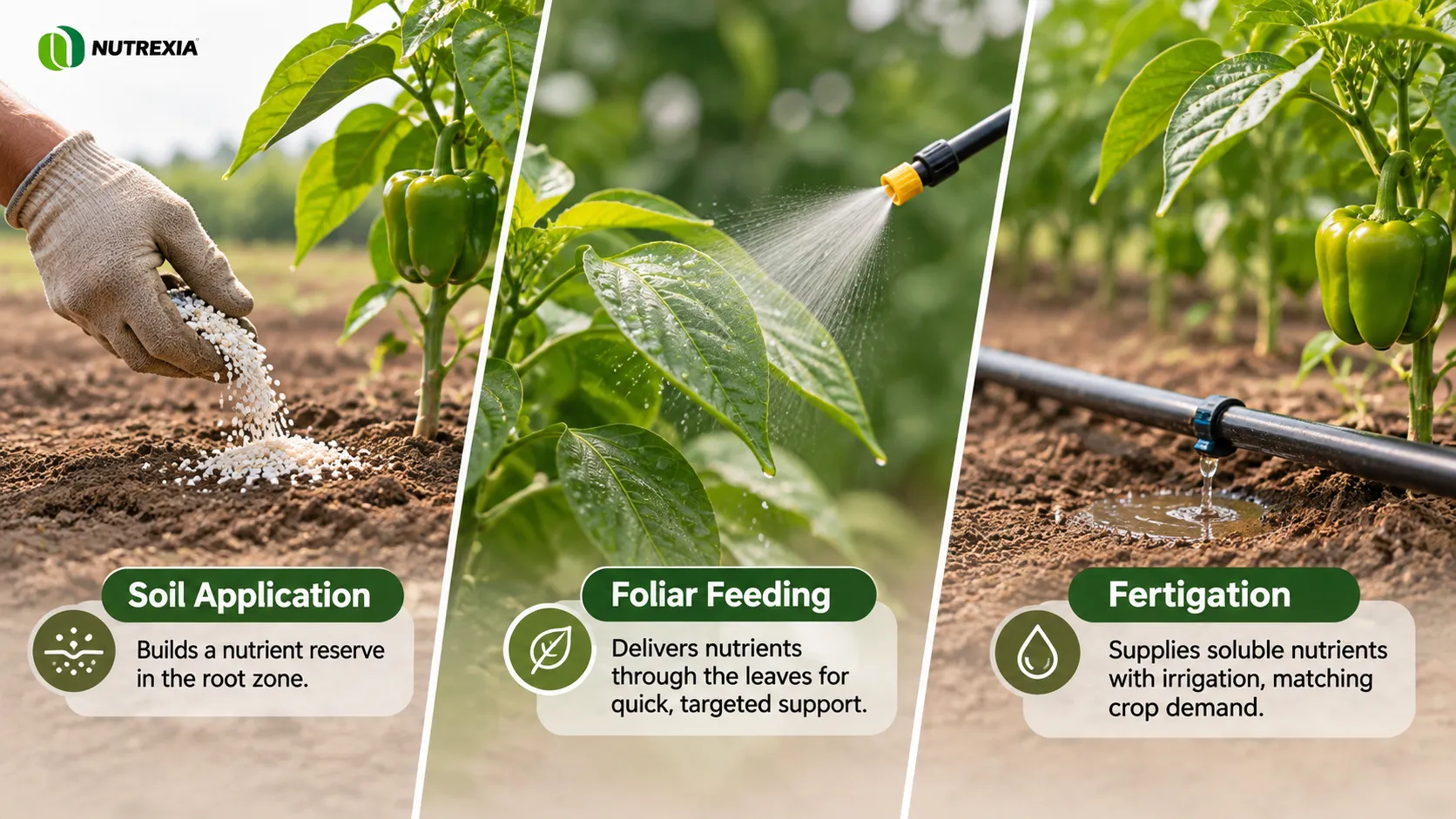
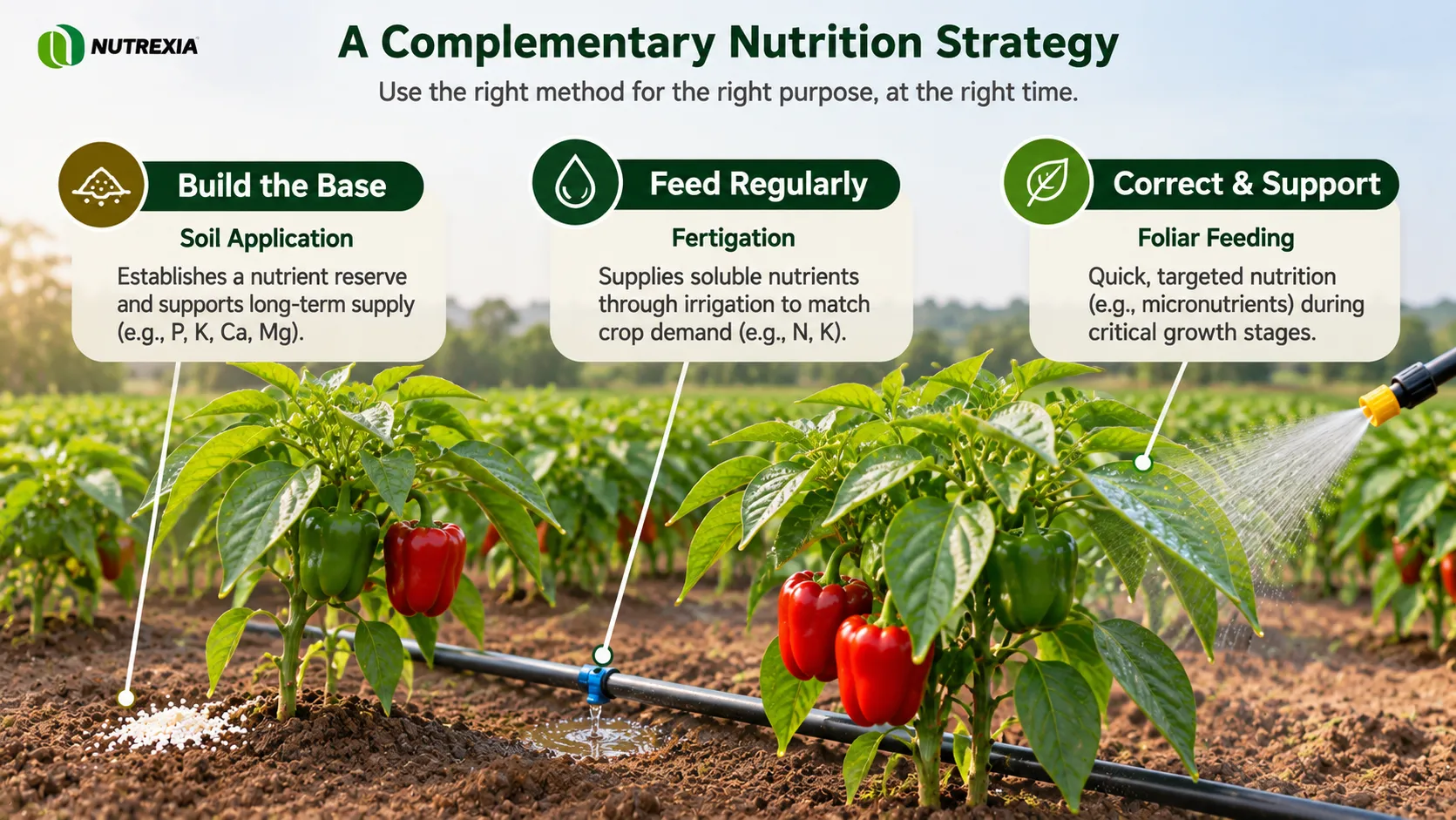
Soil application builds the nutrient base, fertigation follows regular crop demand, and foliar feeding provides fast, targeted support. The best program uses each route for the problem it solves best.

Which fertilizer application method should you choose?
Use soil application to build a dependable root-zone supply, fertigation to match regular crop demand through irrigation, and foliar feeding for fast, targeted support. Strong nutrition programs do not choose one method and reject the others. They combine the routes according to the crop, soil, water, growth stage and confirmed constraint.
This guide is a decision framework, not a universal rate sheet. Final nutrient amounts must come from local soil and water analyses, crop removal or yield targets, plant-tissue testing where appropriate, product labels and qualified local advice.
| Main need | Usually start with | Why |
|---|---|---|
| Build or correct the nutrient reserve before planting | Soil application | Places nutrients where roots can develop and supports season-long supply. |
| Supply repeated nitrogen and potassium demand under drip | Fertigation | Splits soluble nutrients across the demand curve and wetted root zone. |
| Correct a confirmed micronutrient shortage quickly | Foliar feeding | Bypasses a temporarily restricted root pathway with a small targeted dose. |
| Reduce calcium-related fruit risk | Water management and root-zone calcium first | Calcium reaches fruit mainly through root uptake and xylem flow; foliar use is supplemental. |
Why should diagnosis come before the application route?
Nutrient symptoms can resemble drought, salinity, compaction, root disease, cold soil, poor drainage, pH-induced lock-up or spray injury. Before changing the fertilizer route, confirm the most likely constraint.
- Map the pattern: isolated plants, wet spots, soil boundaries, the whole field, old leaves or new leaves.
- Check irrigation uniformity, emitter flow and the wetting pattern before treating uneven growth as a fertility problem.
- Use soil testing to understand the root zone, water analysis to identify what irrigation adds, and tissue testing to show what the crop has absorbed at a defined stage.
- Sample the plant part and growth stage specified for the crop, and compare results with suitable local sufficiency guidance.
- Treat a confirmed problem and then recheck. More fertilizer is not a diagnostic method.
This soil-test interpretation guide explains how pH, electrical conductivity, texture and laboratory results fit into fertilizer planning.
When is soil application the best foundation?
Soil application includes broadcast, banded, incorporated, side-dressed and localized placement. Its role is to establish a nutrient reserve and place nutrients where roots can explore them. It is the core route for nutrients required in large seasonal quantities and for soil constraints that cannot be sprayed away.
Why does placement matter?
A healthy, aerated root zone with suitable pH, salinity and moisture makes every later application method more effective. Phosphorus, potassium and several micronutrients can react with soil minerals. In calcareous, high-pH soils, iron, zinc, manganese and boron availability may be limited even when total soil content is high. Product form and placement therefore matter as much as the nutrient analysis.
| Situation | Practical approach | Watch closely |
|---|---|---|
| Preplant or replanting | Use representative soil tests; incorporate or band according to crop and local guidance. | pH, salinity, compaction, organic matter and rooting depth. |
| Low phosphorus or potassium reserve | Place close enough for young roots without causing seedling salt injury. | Phosphorus moves little; potassium movement depends on soil texture and mineralogy. |
| Orchard or perennial block | Use soil and leaf history; place nutrients in active feeder-root zones. | Fertilizer does not reach roots beneath dry soil merely because it was applied. |
| Alkaline or calcareous soil | Use tested placement and suitable nutrient forms; use foliar feeding only as a targeted bypass. | Bicarbonate and carbonate conditions can restrict several micronutrients. |
Define whether the objective is maintenance, soil build-up or deficiency correction. Sample separate management zones, calculate the nutrient need on the same elemental or oxide basis used by the recommendation and product label, and keep concentrated fertilizer away from seed or young roots unless crop-specific guidance supports that placement.
When is foliar feeding the right tool?
Foliar feeding places a dissolved nutrient on leaf surfaces. A portion can enter through the cuticle and other surface pathways when the spray is correctly formulated, retained and allowed to dry under safe conditions. It can help when roots are temporarily restricted or when soil chemistry reduces nutrient availability. It is not a shortcut around poor rooting, irrigation problems or high macronutrient demand.
Foliar feeding is strongest for:
- a confirmed micronutrient deficiency, especially in high-pH or calcareous conditions;
- temporary support while a cold, saturated, compacted or damaged root zone is corrected;
- a small, compatible dose at a crop-specific developmental stage; or
- a verified shortfall in a greenhouse crop whose main root-zone program is already managed.
It cannot replace drainage, aeration, disease management, a balanced fertigation recipe or a full-season nitrogen, phosphorus and potassium program.
What is a safe foliar sequence?
- Confirm the need and choose a product labeled for the crop and intended use.
- Read the label for timing, concentration, spray volume, pre-harvest interval and tank-mix restrictions.
- Review water quality. High pH, bicarbonate, hardness or suspended solids can affect solubility, compatibility and uptake.
- Make a jar test with the exact water and products. Watch for heat, flakes, sediment, separation or gas.
- Test a small area when using a new product, cultivar, adjuvant or mixture.
- Apply in mild conditions, avoiding heat, drought stress, frost risk, wind and prolonged slow drying. Cover the target without runoff.
- Allow the spray to dry and record the treatment. Reassess the crop in the correct response window.
Why is foliar calcium often overstated?
Foliar calcium is frequently promoted for bitter pit in apple and blossom-end rot in tomato, pepper and cucurbits. Calcium is relatively immobile in the phloem, and developing fruit may receive too little when root uptake or xylem transport is interrupted. A spray deposited on leaves does not reliably redistribute enough calcium to protected fruit tissues.
Direct fruit sprays can increase calcium in treated surfaces in some programs, but they do not consistently solve a whole-plant delivery problem and can mark or burn fruit if misused. Begin with uniform moisture, a functioning root system, suitable root-zone calcium, sensible salinity management, balanced nitrogen, and crop-specific canopy and fruit-load management. Use foliar calcium only as a locally validated supplement. Read the full guide to calcium uptake and deficiency.
How does fertigation match regular crop demand?
Fertigation dissolves suitable fertilizer in irrigation water and injects it into a pressurized system. A well-designed drip system can place soluble nutrients repeatedly in the wetted root volume where active roots are concentrated. Instead of applying one large early dose and hoping it remains available, the seasonal budget can be divided into smaller applications that follow crop demand.
Nitrogen and potassium are commonly fertigated because crops need meaningful quantities and the nutrients can be delivered frequently when soluble sources and water quality allow. Phosphorus, sulfur and micronutrients may also be fertigated, but suitability depends on solubility, water chemistry, compatibility and precipitation risk.
What happens during a reliable fertigation event?
| Step | Action | Purpose |
|---|---|---|
| Check the system | Verify filtration, pressure, flow, valves and emitter uniformity. | Uniform water is the basis of uniform nutrient delivery. |
| Check the water | Review EC, pH, bicarbonate, calcium, magnesium, sodium, chloride and iron where relevant. | Water chemistry affects salinity, precipitation and acidification decisions. |
| Prepare stock | Dissolve compatible materials fully in clean stock tanks and agitate. | Undissolved solids and precipitates can clog emitters. |
| Irrigate first | Establish the intended wetted pattern with clean water. | Prevents concentrated fertilizer from remaining near the inlet or surface. |
| Inject evenly | Meter the calculated solution through the middle portion of the irrigation set. | Improves distribution through the block. |
| Flush | Finish with clean water long enough to clear the laterals and move nutrients into the target zone. | Protects equipment and avoids concentration at line ends. |
| Verify | Log pressure, volume, injector setting and EC; inspect filters and selected emitters. | Turns a schedule into a controllable system. |
Never assume that two soluble fertilizers remain soluble together. Calcium products can precipitate with phosphates or sulfates, especially in hard or high-bicarbonate water. Use separate stock tanks or injection events for incompatible materials. Acids require suitable equipment, training and water-specific guidance.
How should foliar feeding be used in a greenhouse?
In greenhouses, fertigation normally carries the main nutritional load because the crop has a restricted root volume and a managed nutrient solution. Foliar feeding can provide short corrective support after a confirmed deficiency, temporary root stress or a narrow developmental need. It should not become the routine response to an unbalanced substrate EC, pH, irrigation frequency, oxygen supply or nutrient recipe.
For greenhouse tomatoes, first stabilize substrate moisture, drainage where relevant, solution EC and pH, and the nutrient program for the crop stage. Enclosed conditions can slow drying and increase phytotoxicity or disease risk, so ventilate, choose a safe application time and avoid incompatible crop-protection mixtures.
Which route fits each nutrient and growth stage?
| Nutrient or issue | Primary route | When another route helps | Main caution |
|---|---|---|---|
| Nitrogen | Soil base plus fertigation where drip is available | Limited crop-labeled foliar supplementation | Large foliar loads can scorch leaves and distort canopy growth. |
| Phosphorus | Preplant band or placed soil application | Fertigation with a suitable source and water chemistry | Phosphorus moves little and can precipitate with calcium. |
| Potassium | Soil base and/or fertigation | Small urgent foliar supplement | High salt concentration can injure leaves or roots. |
| Calcium | Root-zone supply, water consistency and root health | Direct-fruit or foliar program where locally validated | Foliar calcium does not reliably correct systemic fruit disorders. |
| Iron, zinc, manganese | Soil strategy with a suitable source; foliar often efficient at high pH | Repeated foliar treatment when tests and local practice support it | Correct the pH or root-zone cause where possible. |
| Boron | Soil or foliar according to analysis and crop sensitivity | Targeted foliar use at a specific reproductive window | The margin between deficiency and excess can be narrow. |
Before planting, emphasize soil testing, placement and correction of known root-zone constraints. During establishment, support root growth without salt stress. During rapid canopy expansion and fruit fill, fertigation or side-dressing can follow rising demand. Reserve foliar work for confirmed, crop-specific needs rather than applying it automatically at every stage.
How do you calculate a fertilizer amount without inventing a rate?
These examples demonstrate arithmetic, not crop recommendations. Substitute the nutrient target, product analysis, water volume and injector calibration supplied for the actual field. Keep units consistent and distinguish elemental nutrients from oxide equivalents.
Convert nutrient requirement to product
If a block needs 12 kg of actual potassium (K) in a scheduled application and the soluble product contains 40% K:
Product needed = 12 kg / 0.40 = 30 kg product
If the recommendation is expressed as K2O, do not treat it as elemental K. Convert it or keep the recommendation and label on the same basis.
Check injection concentration
If 30 kg of product is injected into 30,000 L of water:
Concentration = 30,000 g / 30,000 L = 1 g/L product
This only checks the arithmetic. Safety depends on the crop, water EC, existing salts, soil or substrate, irrigation duration, fertilizer source and qualified local guidance.
Set injector run time
If a 100 L stock solution contains the planned fertilizer and the measured injector delivery is 20 L/hour:
Injection time = 100 L / 20 L/hour = 5 hours
Confirm delivery with a measured volume, pre-wet the system and finish with enough clean water to flush the laterals.
How do the three methods work together in real crops?
Wheat without drip irrigation
Start with representative soil testing and a realistic yield target. Place phosphorus and other low-mobility nutrients according to local guidance before or at planting, and split nitrogen to fit rainfall, irrigation and uptake. Use tissue testing or diagnostic strips before foliar micronutrients. Foliar zinc or manganese can correct a confirmed shortage in high-pH soil, but cannot replace base fertility or repair poor drainage and compaction.
A perennial orchard
Use soil, irrigation-water and leaf analyses over time. Place the main nutrient budget in the feeder-root zone and use micro-irrigation to split nitrogen and potassium during demand periods. Combine the root-zone plan with targeted foliar work for recurring micronutrient limitations where local guidance supports it. For calcium-related fruit risk, prioritize water consistency, crop load, nitrogen balance and root health.
Greenhouse tomatoes
Treat fertigation as the daily nutrition engine. Analyze the source water, manage root-zone EC and pH, verify uniformity and drainage, and adjust the recipe to crop stage and fruit load. A labeled foliar treatment can bridge a verified micronutrient shortage or temporary uptake problem. For blossom-end rot risk, stabilize water supply and root-zone salinity first.
What mistakes most often reduce results?
- Using foliar sprays as the main NPK program: leaf-safe doses are limited; use soil application and fertigation for base demand.
- Treating a symptom without checking water and roots: inspect moisture, drainage, EC, irrigation uniformity and root health first.
- Mixing products by intuition: use the label, supplier guidance and a jar test with the actual water.
- Injecting at the start or end of irrigation: pre-wet, inject through the middle and then flush.
- Copying a universal rate: calculate from analysis, crop target, product label and local advice.
- Assuming foliar calcium solves fruit disorders: manage the entire calcium-delivery system and use sprays only as a supplement.
The most reliable program is diagnose -> choose the route -> calculate -> apply -> record -> recheck. Contact Nutrexia to discuss a crop-specific plan based on your soil, water, irrigation layout, growth stage and recent tissue results.
Sources
- Pressurized Irrigation Techniques, Chapter 16: Fertigation, FAO.
- Fertigation: A Tool for Efficient Fertilizer and Water Management, FAO.
- Water Quality for Agriculture, FAO.
- How to Practice Integrated Nutrient Management, FAO.
- Fertilization: Tomato, University of California Statewide IPM Program.
Frequently asked questions
Which fertilizer application method is best?
No single route is best in every situation. Soil application is usually the foundation, fertigation is effective for frequent soluble feeding through irrigation, and foliar feeding is best reserved for small, targeted corrections or temporary support.
Can foliar feeding replace soil fertilization?
Usually not. Leaf-safe doses are limited and cannot reliably supply the large seasonal quantities of nitrogen, phosphorus and potassium that most crops obtain through their roots.
When is foliar feeding most useful?
It is most useful for a confirmed micronutrient shortage, a time-sensitive low-dose treatment, or temporary support when root uptake is restricted. The underlying root, water, pH or salinity problem still needs correction.
What makes fertigation effective?
Effective fertigation depends on uniform irrigation, suitable water quality, fully soluble and compatible fertilizers, calibrated injection, pre-wetting and a clean-water flush after injection.
Does foliar calcium prevent blossom-end rot or bitter pit?
Not by itself. Calcium delivery to fruit depends mainly on root uptake, water movement and xylem transport. Foliar or direct-fruit calcium can only be a supplement in a locally validated program.
About the agronomist

Somayeh Soroush
Plant & Horticultural Expert · Nutrexia R&D Specialist
From productive gardens to advanced greenhouse systems, Somayeh Soroush works where practical horticulture meets modern plant nutrition. She supports progressive growers and greenhouse teams across the Middle East, translating Nutrexia's research into clear, field-ready guidance for diverse crops and growing conditions.
Reviewed by: Somayeh Soroush