Plant Nutrition Fundamentals
Humic Acid and Fulvic Acid in Agriculture: Differences, Benefits, and Applications in Crop Nutrition
Humic acid is generally associated with soil and root-zone support, while the more soluble fulvic fraction is often used in nutrient-delivery strategies. The right choice depends on the formulation, crop, soil, water, and application method.
What is the difference between humic acid and fulvic acid?
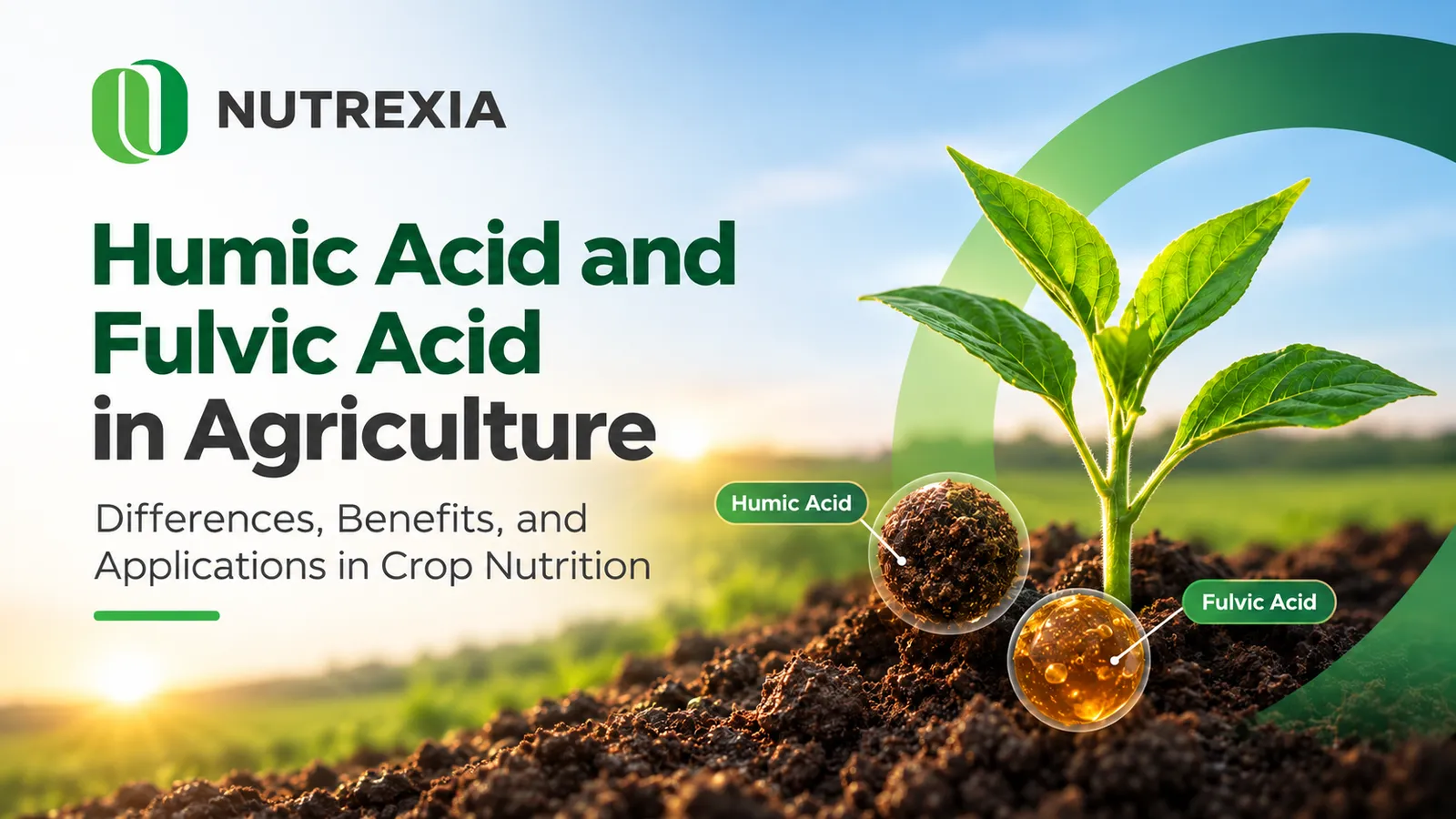
Humic acid and fulvic acid are related fractions of humic substances, but they are not interchangeable. The distinction is based mainly on their behavior during extraction and acidification: humic acid precipitates under strongly acidic conditions, while fulvic acid remains in solution. Fulvic fractions are generally more soluble and mobile, while humic fractions are commonly associated with soil and root-zone applications.
In practice, humic-acid products are often selected to support the soil environment, nutrient retention, and root-zone conditions. Fulvic-acid products are often selected where a soluble formulation and nutrient complexation or delivery are important. These are general tendencies, not universal application rules. Product source, composition, concentration, crop, soil, water quality, and application method all affect performance.
What are humic substances?
Humic substances are complex components of natural organic matter found in soils, water, and organic deposits such as peat, sediments, brown coal, and shale. They form as plant and microbial residues break down and transform over time.
These substances can interact with minerals, nutrients, microorganisms, and other components of the soil environment. Their agricultural effects vary because humic materials are chemically diverse and commercial products differ in source, extraction method, composition, and formulation.
What is humic acid?
Humic acid is the fraction of extracted humic substances that is soluble under alkaline conditions but precipitates when the solution is strongly acidified. Agricultural humic-acid products are commonly used in soil, root-zone, and fertigation programs, depending on their formulation and label.
They may support soil aggregation, water-holding characteristics, microbial activity, nutrient availability, and the conditions around developing roots. Responses are not identical in every field, so humic acid should be treated as one part of a broader soil-management and crop-nutrition strategy rather than as a replacement for fertilizer.
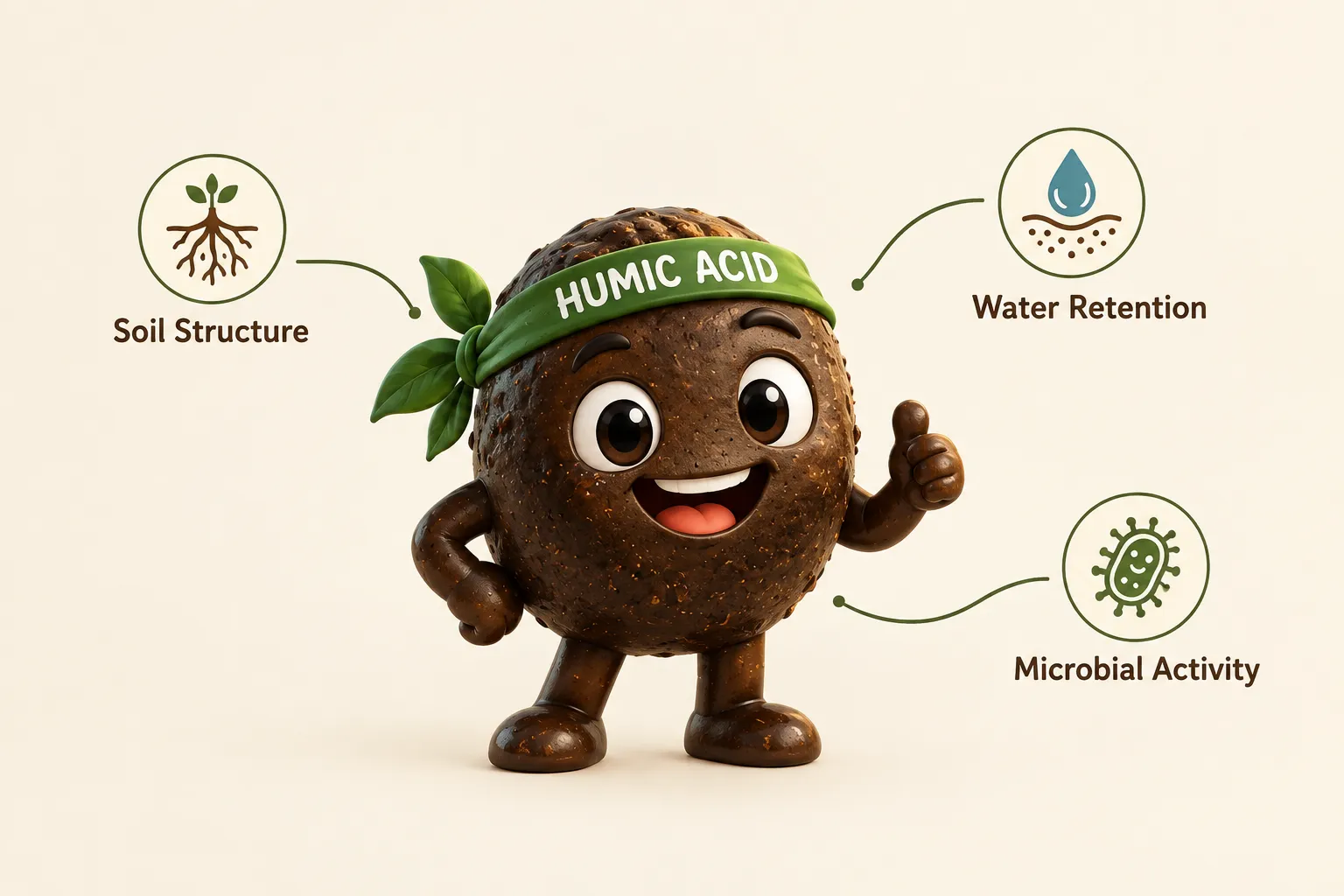
A 2024 meta-analysis of field studies reported average increases in crop yield, nitrogen-use efficiency, and nitrogen uptake following humic-acid application. It also found substantial variation across climate, soil properties, crop types, and fertilization conditions. The averages therefore describe the analyzed research set; they are not a guaranteed response for an individual field or product.
What is fulvic acid?
Fulvic acid is the fraction of extracted humic substances that remains soluble after strong acidification. Fulvic fractions are generally lower in apparent molecular size and more soluble and mobile than humic fractions, although their composition still varies with source and extraction method.
Their solubility and chemical reactivity can make fulvic-acid products useful where nutrient complexation, availability, and delivery are important. Depending on the complete formulation and product instructions, they may be used in soil, fertigation, foliar, or combined nutrient programs.
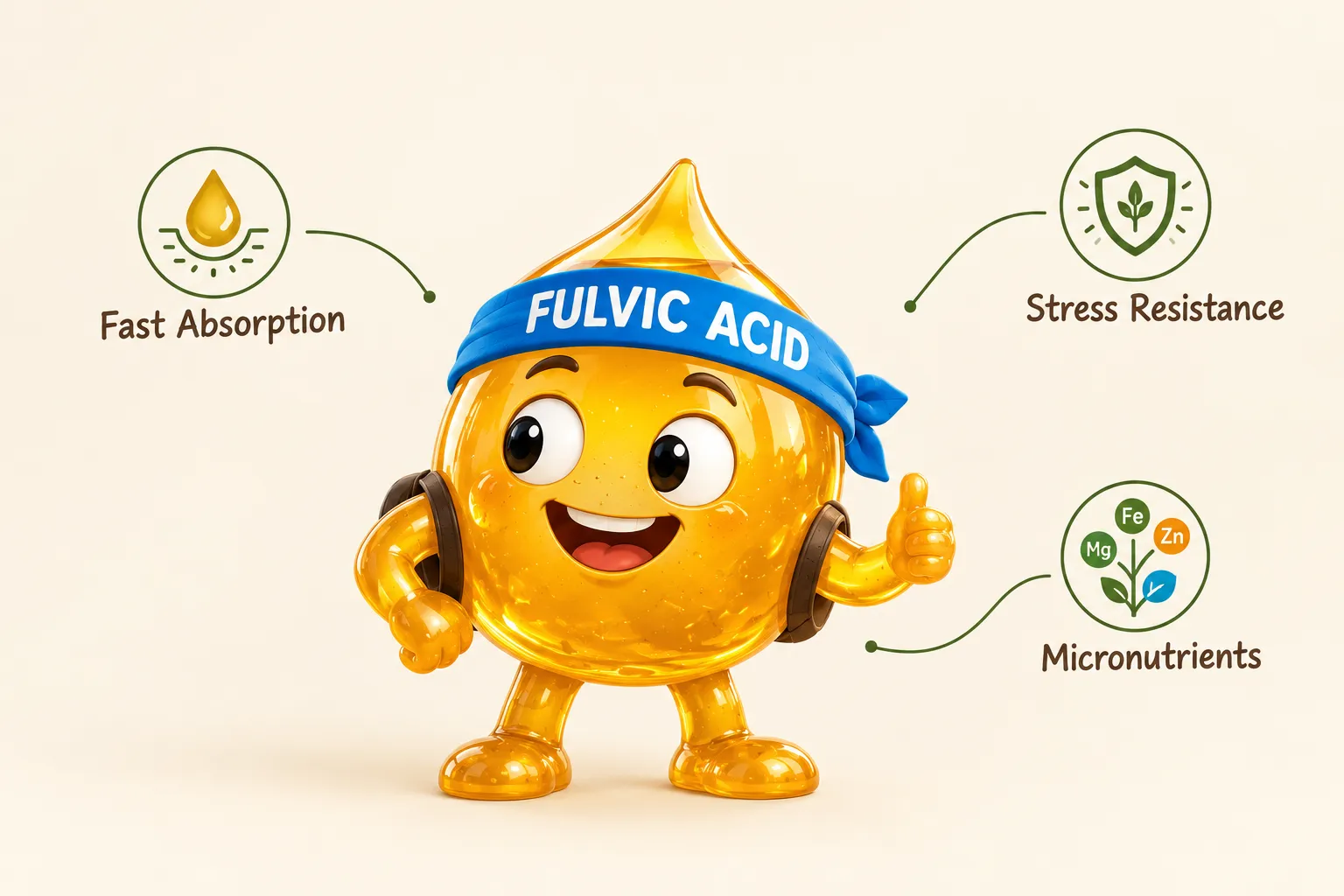
Fulvic substances can interact with mineral nutrients and may help maintain their availability in the growing environment. Their exact behavior depends on the formulation, concentration, water chemistry, nutrient partners, application conditions, and crop.
Humic acid and fulvic acid compared
- Defining behavior: Humic acid precipitates when an alkaline extract is strongly acidified; fulvic acid remains soluble after strong acidification.
- General characteristics: Humic acid is commonly associated with larger, less mobile fractions whose solubility depends strongly on pH. Fulvic acid is generally associated with more soluble, mobile, and lower-apparent-molecular-size fractions.
- Agricultural focus: Humic products commonly focus on the soil environment, root-zone conditions, aggregation, and nutrient retention. Fulvic products commonly focus on nutrient complexation, availability, and soluble delivery strategies.
- Common applications: Humic products are commonly used in soil application and fertigation, depending on formulation. Fulvic products may be used in soil, fertigation, foliar, and nutrient formulations, depending on formulation.
- Role in crop nutrition: Humic fractions can support the environment in which roots, water, nutrients, and microorganisms interact. Fulvic fractions can support nutrient availability and movement within the growing environment.
This comparison describes broad tendencies. A product labeled “humic” or “fulvic” may also contain other components, and its analysis, solubility, pH, concentration, and instructions determine how it should be used.
Can humic acid and fulvic acid work together?
Humic and fulvic fractions can complement each other in a well-designed program. A humic component may focus on the soil and root-zone environment, while a fulvic component may support soluble nutrient complexation and delivery.
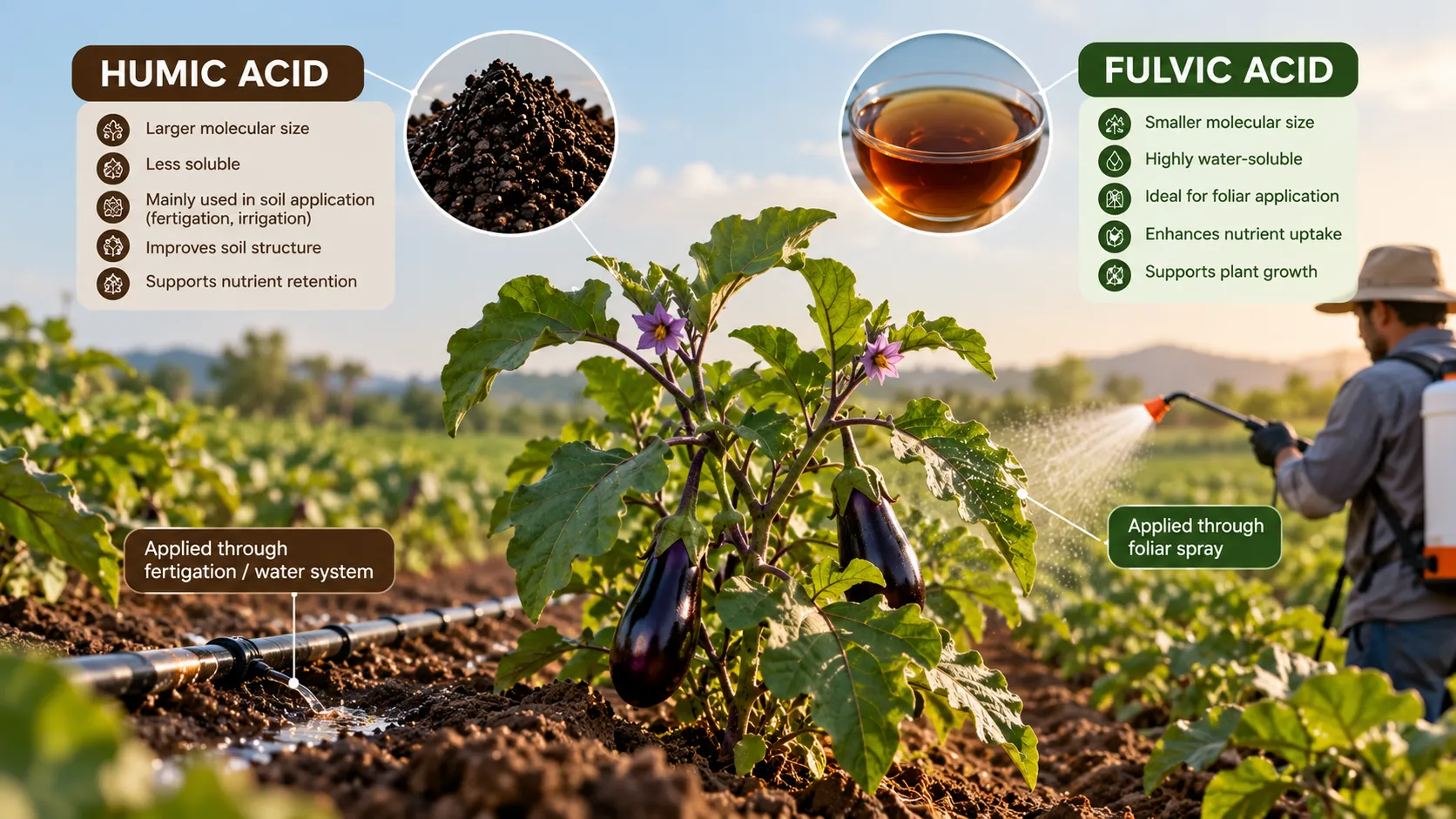
The best combination depends on the crop, soil or substrate, irrigation system, water quality, growth stage, nutritional objective, and the products being combined. Check compatibility before tank mixing, and follow the product label and qualified agronomic advice.
What benefits may they provide in agriculture?
When an appropriate product is integrated into a complete crop-nutrition program, humic or fulvic substances may help with:
- Soil aggregation and water-holding characteristics
- Nutrient availability and nutrient-use efficiency
- Root development and active root-zone conditions
- Beneficial microbial activity around roots
- Micronutrient complexation and availability
- Plant performance under some environmental stresses
- Yield or quality under conditions where the crop responds to the treatment
These are potential functions rather than guaranteed outcomes. The response depends on the product and the production environment.
What determines whether a product will work?
Humic and fulvic products do not perform identically across agricultural conditions. Important variables include:
- Crop species and growth stage
- Soil pH, texture, organic matter, and nutrient status
- Substrate characteristics in soilless systems
- Climate and environmental stress
- Source, extraction process, composition, and concentration
- Application rate, timing, frequency, and method
- Irrigation-water quality
- Compatibility with fertilizers and other crop inputs
Product selection should therefore begin with the crop’s nutritional needs and the production conditions, not with a single general claim about humic or fulvic acid.
How are humic and fulvic acids used in crop nutrition?
Soil and root-zone programs
Soil-applied humic products may be considered when the objective is to support soil properties, the root-zone environment, and nutrient availability. The physical form and solubility of the specific product determine whether it is suitable for broadcasting, incorporation, drenching, or delivery through irrigation.
Fertigation programs
Humic- or fulvic-based formulations may be suitable for fertigation when they dissolve adequately and are compatible with the irrigation water, fertilizers, and equipment. Insoluble material, precipitation, or incompatible mixtures can create operational problems, so a compatibility check is important.
Foliar programs
Some fulvic-based formulations are designed for foliar use because of their solubility and their interaction with mineral nutrients. That does not make every fulvic product foliar-safe. Follow the product label, use an appropriate concentration, confirm tank-mix compatibility, and test a small crop area when advised.
How should you choose between them?
Choose the formulation that matches the agronomic objective:
- Consider a humic-focused product when the priority is the soil and root-zone environment.
- Consider a fulvic-focused product when the priority is a highly soluble nutrient-delivery strategy.
- Consider a combined formulation when both roles are relevant and the analysis and application method fit the program.
Neither material replaces soil or tissue testing, essential plant nutrients, irrigation management, or crop-specific advice. The most useful decision is the one that connects the product’s verified analysis and instructions with the conditions in the field.
Nutrexia crop nutrition solutions
To compare available formulations, browse Nutrexia’s crop nutrition products and consult a qualified agronomist or crop-nutrition adviser before selecting a product, rate, timing, or tank mix.
University research references
- Ma, Cheng, and Zhang. The Impact of Humic Acid Fertilizers on Crop Yield and Nitrogen Use Efficiency: A Meta-Analysis, Agronomy 14, 2763 (2024).
- Yang, Tang, and Antonietti. Natural and artificial humic substances to manage minerals, ions, water, and soil microorganisms, Chemical Society Reviews 50 (2021).
Frequently asked questions
What is the main difference between humic acid and fulvic acid?
The distinction is based mainly on how humic-substance fractions behave during extraction and acidification. Humic acid precipitates under strongly acidic conditions, while fulvic acid remains in solution. In agricultural products, humic fractions are commonly associated with soil and root-zone support, while the more soluble fulvic fraction is often used in nutrient-delivery strategies.
Can humic acid and fulvic acid be used together?
They can be complementary when the formulation, crop, soil, water quality, and application method are suitable. Compatibility and application guidance should be confirmed for the specific products rather than assumed from the ingredient names alone.
Is fulvic acid always suitable for foliar application?
No. Solubility can make fulvic-based formulations relevant to foliar programs, but suitability depends on the complete formulation, concentration, crop sensitivity, water quality, tank-mix partners, and product label.
Do humic and fulvic acids replace fertilizer?
No. They may complement a balanced crop nutrition and soil-management program, but they do not replace the essential nutrients required by the crop.
About the agronomist

Somayeh Soroush
Plant & Horticultural Expert · Nutrexia R&D Specialist
From productive gardens to advanced greenhouse systems, Somayeh Soroush works where practical horticulture meets modern plant nutrition. She supports progressive growers and greenhouse teams across the Middle East, translating Nutrexia's research into clear, field-ready guidance for diverse crops and growing conditions.
Reviewed by: Somayeh Soroush