
Protected Cultivation & Fertigation
Blueberry Fertigation in Peru: EC, Salinity and Fruit Quality
Blueberry fertigation in Peru should balance water quality, nutrient concentration, root-zone EC, drainage and crop response so shallow roots receive enough nutrition without damaging salt accumulation.

How should EC be managed in blueberry fertigation in Peru?
Blueberry fertigation should connect irrigation-water quality, fertilizer concentration, root-zone electrical conductivity (EC), drainage and crop response. The goal is not to maximize EC. It is to supply enough water and balanced nutrition while preventing salts from accumulating around the crop’s shallow, sensitive roots.
This framework is especially relevant to intensive drip-irrigated blueberry production on Peru’s dry northern coast. Exact targets still need to be set for the farm’s water chemistry, cultivar, soil or substrate, crop stage, climate and measurement method. EC is a management signal, not a complete fertilizer recipe.
Why do blueberries need careful root-zone management?
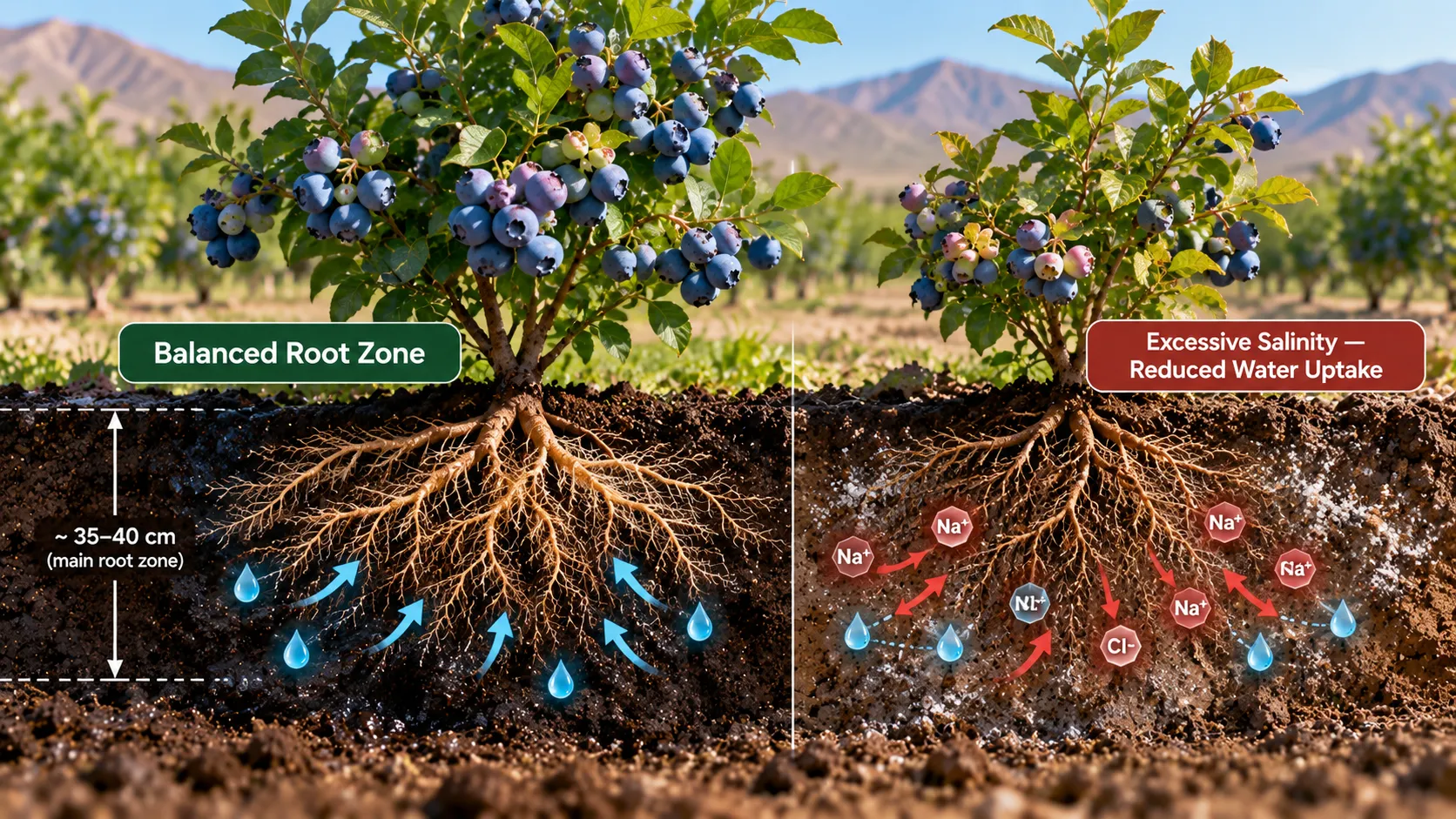
Most blueberry roots occupy roughly the upper 35-40 cm of the root zone. This makes the crop sensitive to both moisture shortage and unfavorable root conditions, particularly during flowering and fruit development. Highbush blueberries also generally perform in an acidic root environment; a pH of about 4.5-5.5 is commonly associated with suitable production, although the appropriate range depends on the system and substrate.
The practical challenge is to keep the root zone moist and acidic while controlling dissolved salts. Too little irrigation causes water stress. Excess salts from water or fertilizer raise osmotic pressure, making water harder for roots to absorb even when the soil or substrate looks wet.
What does EC mean in blueberry fertigation?
Electrical conductivity indicates the concentration of dissolved ions that conduct electricity. Those ions may come from the source water, fertilizer, naturally occurring salts, soil or substrate minerals and other amendments. As their combined concentration rises, EC generally rises.
EC does not reveal which ions are present or whether the nutrient balance is correct. Two solutions can show a similar EC while containing very different proportions of nitrogen, potassium, calcium, magnesium, sulfate, sodium or chloride. Interpret EC together with water analysis, nutrient concentrations, pH, crop stage, drainage and plant response.
Why are blueberries sensitive to salinity?
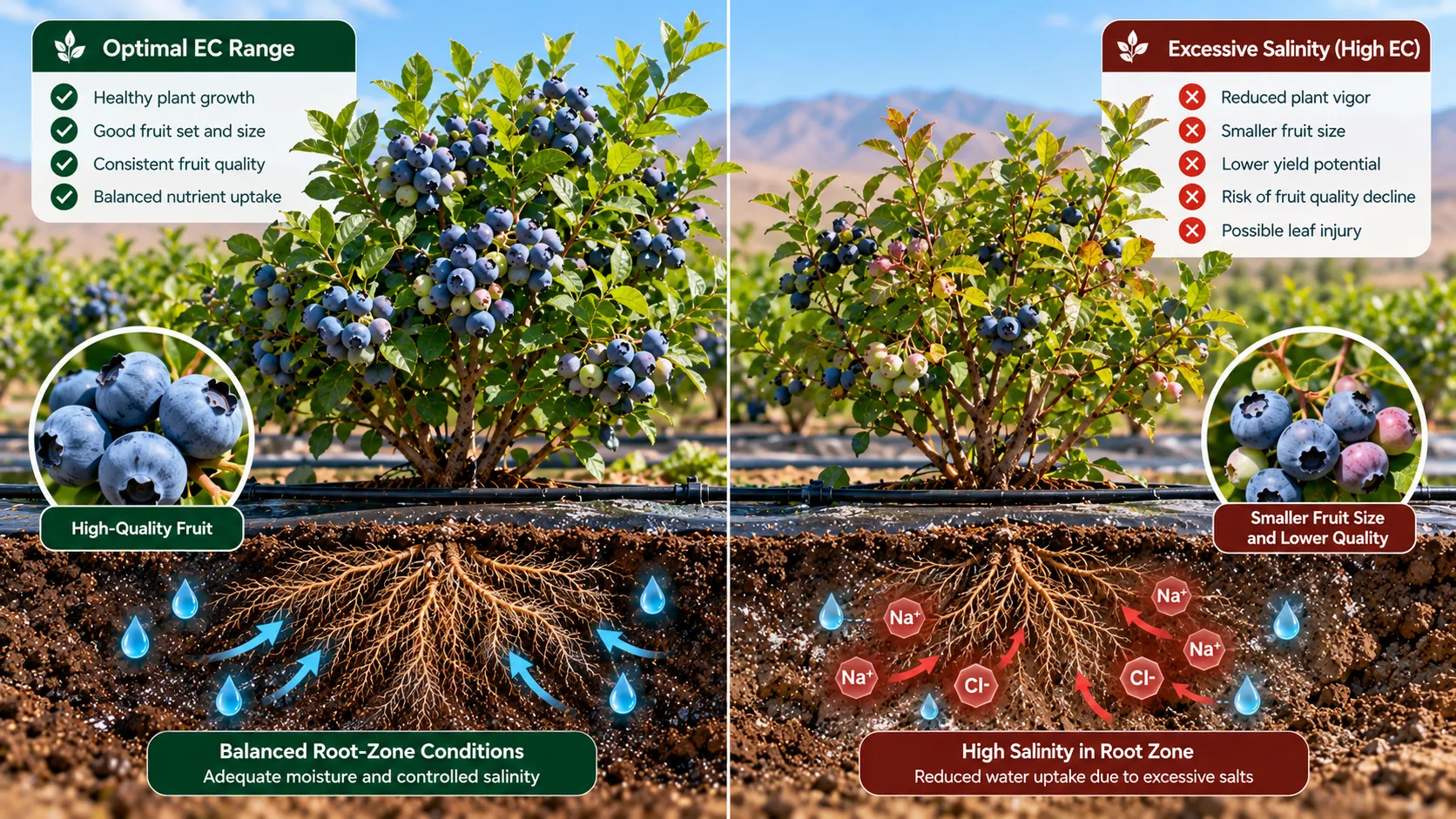
High salinity reduces the plant’s ability to take up water. Continued exposure can contribute to leaf injury, weaker growth, lower yield and declining fruit quality. Salts enter through irrigation water, fertilizers, soil or substrate and amendments; they leave mainly through plant uptake and drainage or leaching. Accumulation begins when salt inputs exceed removal.
Fertigation improves distribution and allows smaller, more frequent nutrient applications, but it can still raise root-zone EC when fertilizer concentration or total application is excessive. Long-term highbush blueberry research summarized in the source material found that increasing nitrogen fertigation raised soil EC, while excessive nitrogen was associated with lower berry yield and greater nutrient-loss risk.
Why should irrigation-water EC be checked first?
The fertilizer solution starts with the water. If the source water already carries a substantial dissolved-salt load, every fertilizer addition increases the final ionic concentration.
A useful water analysis includes EC and pH plus relevant bicarbonate, carbonate, calcium, magnesium, sodium, chloride, sulfate, nitrate and other ions. Fertilizer EC and water EC should not be treated as separate problems. A recipe designed without the existing water chemistry can push the applied solution and root zone beyond the intended range.
Does higher EC produce better blueberry performance?
No. Research described in the source document shows that the highest nutrient-solution concentration did not automatically produce the best overall result. An intermediate treatment provided a more balanced outcome. Work with ‘Biloxi’ blueberry also found that yield depended on the interaction between EC and the nitrate-to-ammonium ratio, while soluble-solids values stayed within a relatively narrow range.
The lesson is to separate nutrient concentration from nutrient balance. Sufficient nutrition with minimal unnecessary salt accumulation is a better objective than maximum EC.
Can one EC target be used on every blueberry farm?
Research has reported blueberry sensitivity to soil EC above about 1.5-2.0 dS/m under some conditions, but this is not a universal threshold. Successful nutrient-solution ranges vary with water quality, cultivar, substrate, climate and management.
An EC value from irrigation water, a fertilizer tank, a soil extract, substrate solution or drainage does not represent the same root condition. Sampling method and location matter. Establish a farm-specific operating range from baseline water quality, production system, crop stage and historical plant response.
Which EC measurements should be compared?
The injector reports what is delivered, not necessarily what roots experience. Plants remove water, evaporation and transpiration concentrate the remaining solution, and drainage moves salts out. Monitor four points:
- Source-water EC establishes the incoming salt load.
- Final fertigation-solution EC confirms what reaches the irrigation system after injection.
- Root-zone EC shows the environment around active roots.
- Drainage EC helps reveal whether salts are concentrating or being removed.
Compare these values over time. A widening difference between applied and root-zone or drainage EC can be more informative than one isolated measurement.
How do irrigation frequency and drainage affect salinity?
Because roots are shallow, irrigation should maintain moisture without prolonged waterlogging. Frequent, controlled applications can stabilize the root zone, but the schedule must respond to crop water demand, weather, evapotranspiration, soil or substrate characteristics, moisture, drainage and crop stage.
Irrigating more often is not enough by itself. The objective is a stable relationship between water supply, nutrient delivery, plant uptake and drainage. Poor drainage can allow salts to remain even when irrigation volume appears adequate.
Why must pH and EC be managed together?
pH describes acidity or alkalinity; EC describes the concentration of conductive dissolved ions. A solution can have acceptable EC but unsuitable pH, or suitable pH with excessive EC.
Blueberries benefit from an appropriately acidic root zone. Nitrogen form also affects this environment: ammonium nutrition can contribute to acidification, but excessive application can increase EC and losses. Fertilizer decisions should therefore follow crop demand and analytical results rather than using EC alone.
How can salinity influence blueberry fruit quality?
Fruit size, firmness, soluble solids, acidity, color, anthocyanins and overall composition can all respond to water and salinity stress. The response is not linear. Mild controlled stress may alter some secondary metabolites, but the result depends strongly on cultivar, developmental stage, environment and stress intensity.
Deliberately raising EC to improve quality is therefore not a reliable general strategy. Excessive salinity can restrict water uptake, damage leaves and roots, reduce productivity and compromise marketable fruit.
What practical EC monitoring cycle can growers use?
- Analyze the irrigation water. Measure EC, pH and major ions before designing the program.
- Measure the final solution. Check EC and pH after injection instead of relying on a theoretical fertilizer concentration.
- Monitor the root zone. Track EC and moisture regularly; a sustained rise can indicate accumulation.
- Check drainage. Compare drainage EC with the applied and root-zone values.
- Read the crop. Record shoot growth, leaf condition, flowering, fruit set, berry size, firmness, yield, soluble solids and vigor.
- Diagnose before adjusting. Determine whether rising EC comes from source water, fertilizer concentration, total fertilizer input, insufficient irrigation, poor drainage, high evaporative demand or particular ions.
Correct the cause rather than reacting to the number alone. Reducing every nutrient indiscriminately can create a new imbalance without solving the original salinity problem.
Which principles matter most for Peruvian blueberry production?
- Start with a complete water analysis.
- Keep nutrient concentration and nutrient balance as separate decisions.
- Avoid assuming that higher EC means higher yield.
- Use small, well-distributed fertigation events where appropriate.
- Monitor the active root zone, not only the injector.
- Use drainage to understand salt movement and nutrient loss.
- Manage pH and EC together.
- Adapt water and nutrient supply to crop stage and demand.
- Judge the program by plant performance and marketable fruit, not an arbitrary meter reading.
What is the main takeaway?
Successful blueberry fertigation is a balance between enough water and nutrition and the crop’s sensitivity to salts. The most useful management sequence is:
Water quality -> fertigation concentration -> root-zone EC -> drainage -> plant response -> fruit quality
Connecting those measurements helps Peruvian growers manage the root zone according to crop demand instead of applying fertilizer simply to increase concentration. Contact Nutrexia to discuss water analysis, fertigation and crop-nutrition planning for your production conditions.
Frequently asked questions
What does EC show in a blueberry fertigation program?
EC indicates the total concentration of electrically conductive dissolved ions. It helps monitor concentration and salinity, but it does not identify which nutrients are present or whether their proportions are suitable.
Is a higher fertigation EC better for blueberry yield?
No. More concentrated fertilizer can raise root-zone salinity without improving crop performance. The objective is adequate, balanced nutrition with the least unnecessary salt accumulation.
Where should EC be measured?
Monitor source water, the final fertigation solution, the active root zone and drainage. Trends and differences between these points are usually more useful than one isolated reading.
Can growers use one universal EC target for blueberries?
No single number fits every farm. Water chemistry, cultivar, substrate or soil, crop stage, climate, sampling method and drainage all affect how an EC value should be interpreted.
About the agronomist

Somayeh Soroush
Plant & Horticultural Expert · Nutrexia R&D Specialist
From productive gardens to advanced greenhouse systems, Somayeh Soroush works where practical horticulture meets modern plant nutrition. She supports progressive growers and greenhouse teams across the Middle East, translating Nutrexia's research into clear, field-ready guidance for diverse crops and growing conditions.
Reviewed by: Somayeh Soroush