Nutrient Deficiency & Crop Problems
Why Are Plant Leaves Turning Yellow? A Nutrient Diagnosis Guide
Yellow leaves are a warning sign, not a diagnosis. Use leaf age, the pattern of chlorosis, field distribution, root-zone conditions and soil or tissue testing to distinguish nutrient deficiency from pH, water, salinity and root problems.
Why do plant leaves turn yellow?
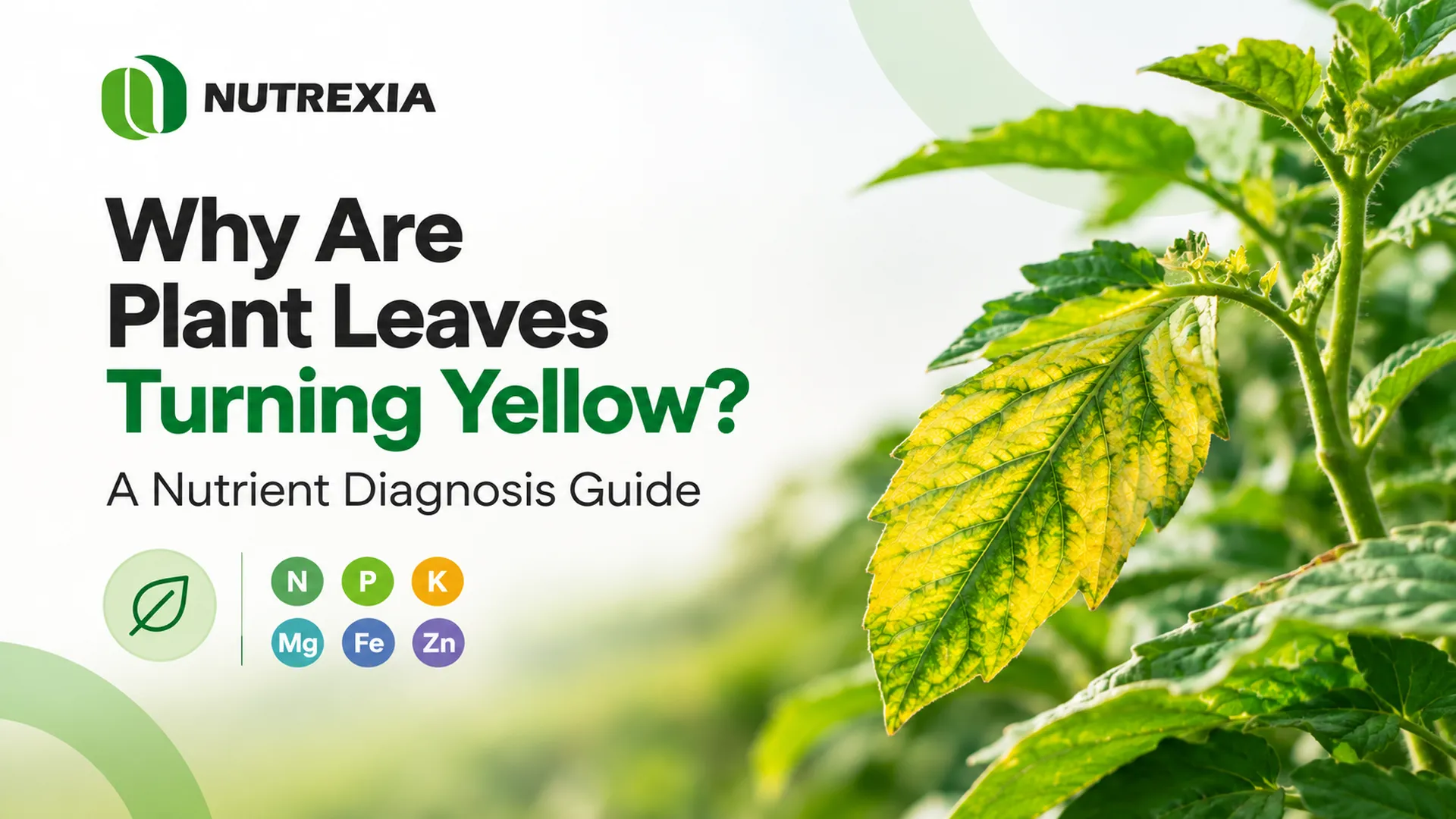
Plant leaves turn yellow when chlorophyll is lost or fails to develop normally, a condition known as chlorosis. Nutrient deficiency is one possible cause, but yellowing can also develop when roots cannot access nutrients because of unsuitable soil pH, waterlogging, compaction, salinity, root damage or nutrient interactions.
Because chlorophyll is essential for photosynthesis, prolonged chlorosis can reduce growth, crop productivity and quality. The practical rule is simple: yellow leaves are a warning sign, not a diagnosis. Observe where the symptoms begin, how the yellowing is distributed and what is happening in the root zone before choosing a corrective treatment.
This guide presents a globally applicable diagnostic framework. Crop-specific sufficiency ranges, sampling methods and fertilizer recommendations still need to come from a qualified laboratory, agronomist or local authority.
How should yellow leaves be diagnosed in the field?
Check which leaves turn yellow first
- Older, lower leaves: often suggest a problem with a relatively mobile nutrient, especially nitrogen or magnesium. Plants can move these nutrients from older tissue toward active growth.
- Young, upper leaves: may suggest a less-mobile nutrient such as iron because the plant cannot redistribute enough of it from mature tissue.
- Leaves throughout the plant: can indicate a severe or widespread nutrient shortage, but may also reflect waterlogging, salinity, restricted roots or another environmental stress.
Leaf age narrows the possibilities; it does not identify the cause by itself.
Examine the pattern of yellowing
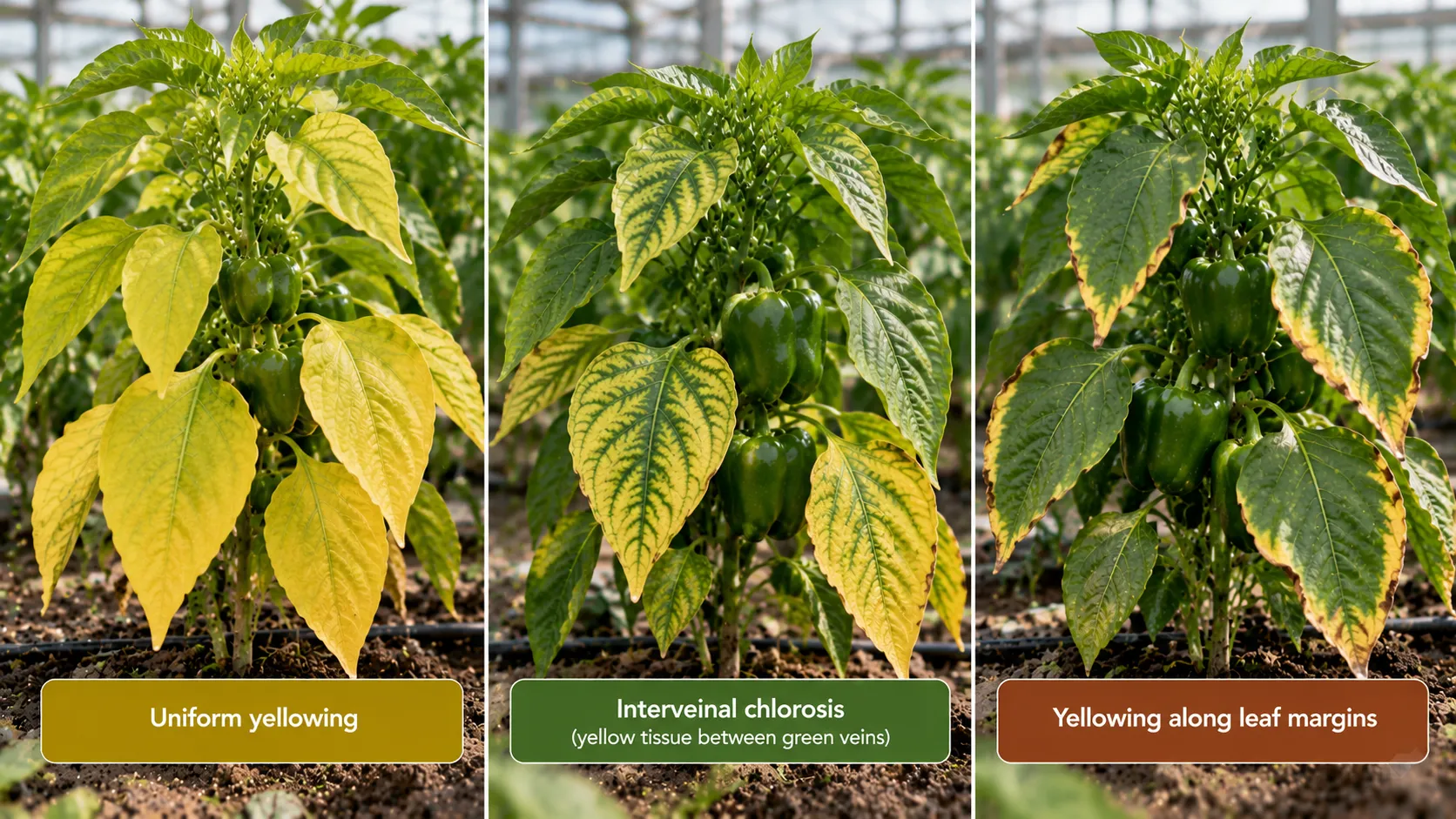
- Uniform yellowing: commonly associated with nitrogen deficiency, although sulfur deficiency and root problems can look similar.
- Yellow tissue between green veins: called interveinal chlorosis. Magnesium deficiency often affects older leaves, whereas iron deficiency usually affects younger leaves.
- Yellowing along leaf margins: may be associated with potassium deficiency, particularly when the edges later become brown or scorched.
- Yellowing with deformation or dead tissue: may indicate a more severe nutrient disorder, toxicity, root injury or disease.
Look at the pattern across the field
Step back from the individual leaf. Symptoms that follow irrigation lines, collect in low areas or appear in distinct patches may point to drainage, irrigation, salinity or soil variability. Uniform symptoms across a large area can indicate a widespread management issue, while scattered plants may suggest localized root damage, disease or uneven fertilizer placement.
The field nutrient-deficiency diagnosis guide explains how to combine spatial patterns, leaf symptoms and comparative sampling.
Which nutrient deficiencies can cause yellow leaves?
Several nutrients are involved in chlorophyll production, photosynthesis, water regulation and plant growth. Their symptoms overlap, so the descriptions below are diagnostic clues rather than final conclusions.
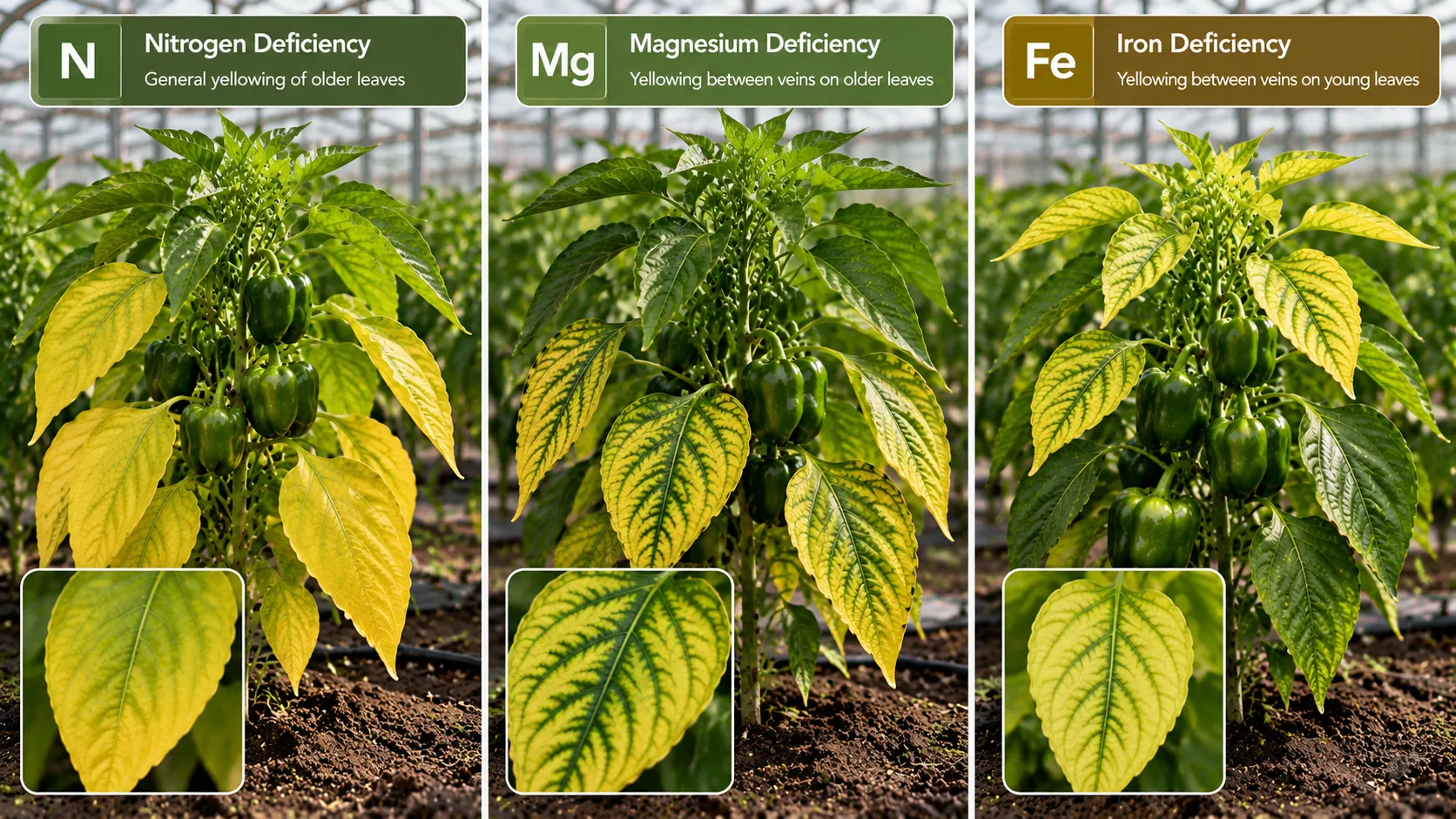
Nitrogen deficiency: general yellowing of older leaves
Nitrogen supports chlorophyll, proteins, enzymes and growth. When supply is inadequate, older leaves often become pale green and then yellow as nitrogen is transferred toward younger tissue. Plants may grow slowly and lose yield potential.
Review fertilizer history, crop stage, soil moisture and possible nitrogen losses. Nitrate can leach below the root zone in coarse soil, and waterlogged conditions can promote denitrification. Confirm that supply is inadequate before adding more nitrogen.
Magnesium deficiency: interveinal chlorosis on older leaves
Magnesium is the central atom in the chlorophyll molecule and supports photosynthesis and enzyme activity. Because it is mobile in the plant, deficiency commonly appears first on older leaves as yellow tissue between relatively green veins. Brown or dead patches can develop in advanced cases.
Check older foliage and soil or substrate results. Excess potassium or other cations can sometimes interfere with magnesium uptake, so correcting nutrient balance may matter as much as supplying magnesium.
Iron deficiency: yellow young leaves with green veins
Iron is required for chlorophyll formation and energy-transfer processes. Deficiency usually affects the youngest leaves first; tissue turns yellow while veins remain green, and severe cases may produce nearly white new leaves.
Iron deficiency is common in alkaline or calcareous conditions where iron is present but poorly available. Cold, wet soil and weak roots can also restrict uptake. Measure pH and inspect drainage and root health before selecting a treatment. An appropriate chelate or foliar treatment may help in some systems, but effectiveness depends on crop, chemistry and the iron source.
Potassium deficiency: yellow and scorched leaf edges
Potassium regulates water relations, stomatal function, enzyme activity and sugar movement. Deficiency often starts on older leaves, with yellowing at the margins and tips that can progress to brown scorch. Reduced vigor and weaker tolerance of environmental stress may follow.
Review soil potassium, fertilizer history, soil texture and irrigation. Potassium can leach from coarse soil, while excessive magnesium or calcium may contribute to imbalance under some conditions.
Sulfur and other nutrient deficiencies
Sulfur is needed for amino acids, proteins and enzymes. Its deficiency can cause relatively uniform paleness and reduced growth, often appearing on younger leaves because sulfur is less readily redistributed than nitrogen in many plants.
Manganese and zinc deficiencies can also cause chlorosis, sometimes with interveinal patterns. Calcium and boron deficiencies more often damage or distort young tissue and growing points than produce simple uniform yellowing. Copper deficiency can also affect new growth. When symptoms overlap, soil and plant tissue analysis provide stronger evidence than appearance alone.
Why can deficiency occur when nutrients are present?
A true deficiency occurs when plant-available supply is too low for crop demand. An induced or functional deficiency occurs when the nutrient is present but conditions restrict its availability, root uptake or transport inside the plant. Adding fertilizer may not solve the second problem.
Unsuitable soil pH
Soil pH strongly influences nutrient solubility. In alkaline or calcareous soils, iron, zinc, manganese and phosphorus may become less available. Strongly acidic conditions can increase the availability of some elements to toxic levels while reducing the availability of others. The appropriate range depends on the crop and growing system, so measure pH before choosing a correction.
Waterlogging, compaction and root damage
Roots need oxygen for respiration and active uptake. Saturated or compacted soil restricts oxygen, root growth and nutrient acquisition. Waterlogging can also change the chemical forms of iron and manganese and encourage nitrate loss through denitrification. Root diseases, nematodes and physical injury can create similar symptoms.
Nutrient interactions and imbalance
An excessive supply of one element can sometimes interfere with another. High potassium, for example, can contribute to magnesium deficiency under certain conditions. Excessive nitrogen can increase vegetative growth and the crop’s demand for other nutrients. Evaluate the full program rather than treating each nutrient in isolation.
Leaching, salinity and irrigation
Nitrate, sulfate, magnesium and other mobile nutrients can move below the active root zone when excess water drains through coarse soil. At the same time, high soluble-salt concentrations make water uptake more difficult and can disturb nutrient balance. If salinity is suspected, measure electrical conductivity (EC) and irrigation-water quality. Applying more fertilizer can make salt stress worse.
Immature organic material
When high-carbon organic material decomposes, microorganisms may temporarily immobilize nitrogen. Fresh or incompletely decomposed amendments can therefore contribute to nitrogen shortage, depending on their composition, maturity, rate and soil conditions. They may also add nutrients and salts, so include them in the nutrient plan.
The soil-test interpretation guide provides a broader framework for evaluating pH, EC, nutrient supply and field context.
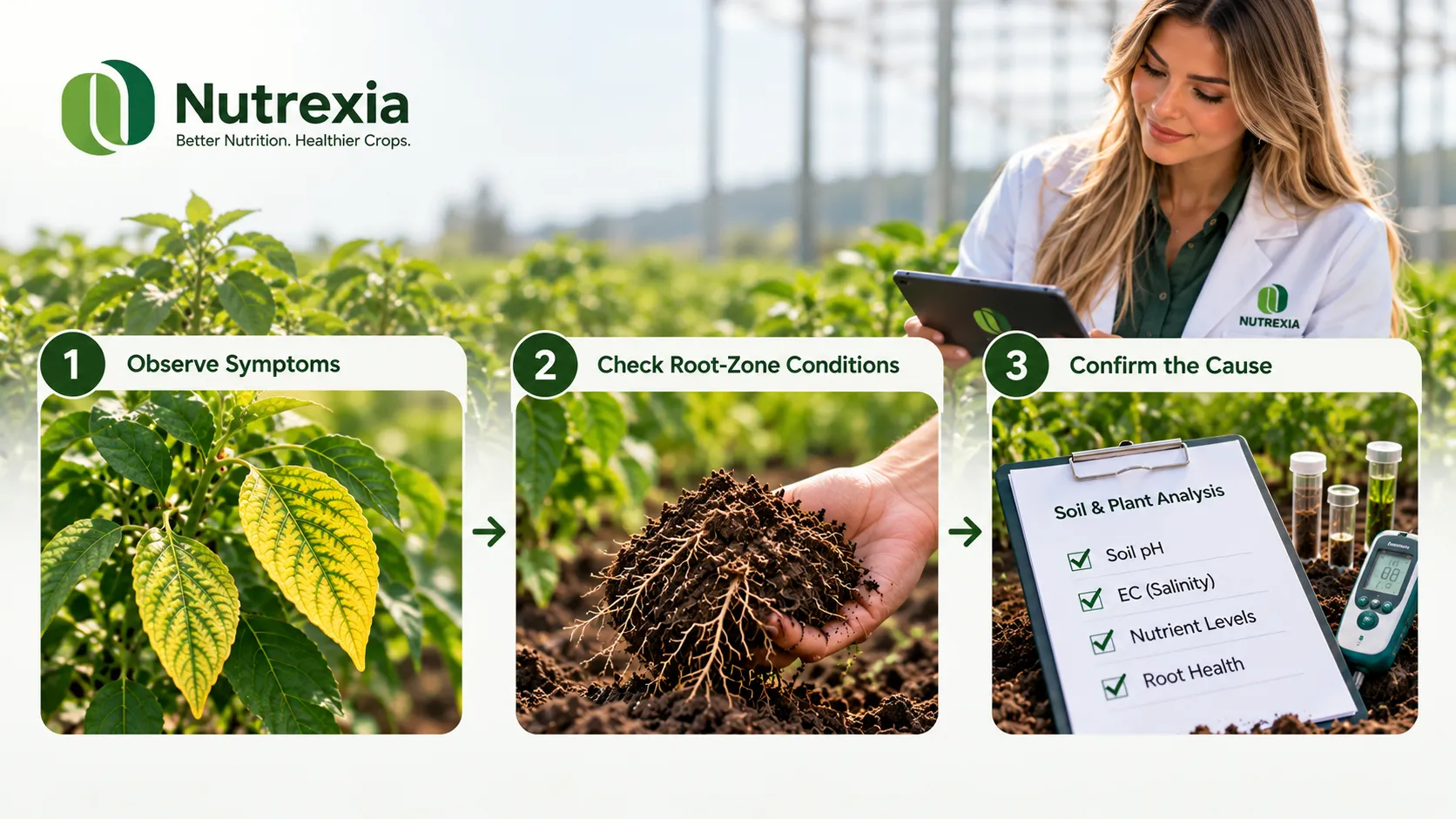
What is a practical diagnosis workflow?
- Record the symptoms: note leaf age, uniform or interveinal yellowing, edge burn, deformation, wilting and reduced growth.
- Map the field pattern: determine whether symptoms are widespread, patchy, aligned with irrigation or concentrated in wet areas.
- Review recent management: check fertilizer applications, rainfall, irrigation, temperature changes and pesticide use.
- Inspect the root zone: look for waterlogging, compaction, poor drainage, discoloration, damage and restricted rooting depth.
- Test soil, substrate or water: assess nutrient status, pH, EC and irrigation-water chemistry as appropriate.
- Use tissue analysis when needed: confirm whether the plant has a low nutrient concentration when symptoms overlap or soil results do not explain the problem.
- Choose a targeted correction: address the nutrient shortage or the environmental cause, then monitor new growth. Existing yellow leaves may not fully recover their color.
How can yellow leaves be prevented?
- Build a routine around representative soil or substrate testing.
- Balance macro- and micronutrients instead of focusing only on N-P-K.
- Maintain appropriate moisture, drainage and root-zone aeration.
- Match fertilizer timing and quantity to crop demand, soil supply and leaching risk.
- Monitor nutrient interactions and avoid applications that create imbalance or excessive salinity.
- Combine regular field scouting with laboratory results so developing problems are found early.
No single fertilizer can correct every cause of yellow leaves. A reliable program integrates soil information, crop requirements, irrigation management and repeated observation.
Diagnose before you fertilize
Nitrogen deficiency can cause general yellowing on older leaves, magnesium deficiency often produces interveinal chlorosis on older foliage, and iron deficiency commonly affects young leaves while the veins remain green. Similar symptoms, however, can develop when pH, waterlogging, salinity, root damage or nutrient interactions restrict uptake.
Identify the likely cause, confirm it with appropriate testing and choose a targeted correction. This improves fertilizer efficiency and protects crop productivity without adding inputs that may not address the real problem.
Contact Nutrexia to discuss crop nutrition using information about the crop, growth stage, soil and water conditions, field pattern and available test results.
Scientific references
- Iowa State University Extension. Identifying Plant Nutrient Deficiencies: Iron.
- University of California Statewide IPM Program. Nutrient Deficiencies: Nitrogen, Zinc and Iron.
- Washington State University Extension. Plant Mineral Nutrition and Fertilizers.
- Virginia Cooperative Extension. Agronomy Handbook: Soil Testing and Plant Analysis.
Frequently asked questions
Does every yellow leaf mean nitrogen deficiency?
No. Nitrogen deficiency commonly causes general yellowing on older leaves, but sulfur deficiency, waterlogging, root damage, unsuitable pH, salinity, disease and other stresses can produce similar symptoms. Confirm the likely cause before applying nitrogen.
How can leaf age help identify a nutrient deficiency?
Symptoms on older leaves often point toward relatively mobile nutrients such as nitrogen or magnesium, while symptoms on young leaves can point toward less-mobile nutrients such as iron. Leaf age is a useful clue, not proof, because root and environmental stresses can alter the pattern.
What does yellow tissue between green veins mean?
This pattern is called interveinal chlorosis. On older leaves it can be associated with magnesium deficiency; on young leaves it can be associated with iron deficiency. Crop, leaf age, soil pH, root health and laboratory results should be considered together.
Can plants be nutrient deficient when the soil contains the nutrient?
Yes. Unsuitable pH, waterlogging, compaction, salinity, damaged roots and nutrient imbalances can restrict availability, uptake or transport even when a soil test shows that the nutrient is present.
What should I test before correcting yellow leaves?
Start with the field pattern, leaf age and symptom type, then inspect irrigation, drainage and roots. Depending on the problem, soil or substrate pH, electrical conductivity, nutrient analysis, irrigation-water quality and plant tissue analysis can help confirm the cause.
About the agronomist

Somayeh Soroush
Plant & Horticultural Expert · Nutrexia R&D Specialist
From productive gardens to advanced greenhouse systems, Somayeh Soroush works where practical horticulture meets modern plant nutrition. She supports progressive growers and greenhouse teams across the Middle East, translating Nutrexia's research into clear, field-ready guidance for diverse crops and growing conditions.
Reviewed by: Somayeh Soroush